

Sebastian Munster (1489 - 1552)
Profile :
After Waldseemuller three names dominated cartography in the 16th century; Mercator, Ortelius & Munster, and of these three Munster probably had the widest influence in spreading geographical knowledge throughout Europe in the middle years of the century. His Cosmographica, issued in 1544, contained not only the latest views of many well known cities, but included an encyclopedic amount of detail about the known – and unknown – world and undoubtedly must have been one of the most widely read books of its time, going through nearly forty editions in six languages.
An eminent German mathematician and linguist, Munster became professor of Hebrew at Heidelberg and later at Basle, where he settled in 1529. In 1528, following his first mapping of Germany, he appealed to German scholars to send him descriptions, so that all Germany with its villages, towns, trades etc. may be seen in a `mirror`, even going so far as to give instructions on how they should map their own localities. The response was far greater than expected and much information was sent by foreigners as well as Germans so that, eventually, he was able to include many up-to-date, if not very accurate, maps in his atlases. He was the first to provide a separate map of each of the four known continents and the first separately printed map of England. His maps, printed from woodblocks, are now greatly valued by collectors. His two major works, the Geographia and Cosmographia were published in Basle by his sep-son, Henri Petri, who continued to issue many editions after Munsters death of the plague in 1552.
Munster’s dominance of the cartographic market was relatively short lived once Ortelius produced his “Theatrum Orbis Terrarum” in 1570. Munster's somewhat naive engravings of the world, continents and countries were revised and re-published by Sebastian Petri with more sophisticated maps in 1588, using the Ortelius Atlas as a guide. In Munsters defense though, he had little in the way of examples or reference to help produce what was the first comprehensive atlas of the known world.
Sebastian Munster'sGeographia (first published in 1540) and his later Cosmographia (first published in 1544) were cartographic landmarks. TheGeographia included not only Ptolemaic maps, but also a number of landmark modern maps, including the first separate maps of the 4 continents, the first map of England and the earliest obtainable map of Scandinavia. The Cosmographia was the earliest German description of the world and a major work in the revival of geographic thought in 16th-century Europe. Altogether, about 40 editions of the Cosmographia appeared between 1544 and 1628.
Munster dominated cartographic publication during the mid-16th Century and is generally regarded as one of the important map makers of the 16th Century. Originally a scholar studying Hebrew, Greek and mathematics, Munster (1489-1552) eventually specialised in mathematical geography and cartography. He is best known for his edition of the Geographia, a translation of Ptolemy's landmark geographical text. Munster's version is illustrated with maps based on Ptolemy's calculations, but also, in recognition of the increased geographical awareness of the period, contains a section of modern maps including the first set of maps of each continent. In the first edition of the Geographia, Munster included twenty-seven ancient Ptolemaic maps and twenty-one modern maps, printed from woodblocks. Subsequent editions of the Cosmographia much expanded his Geographia and contained a vast number of maps and plans.
Sebastian Munster (1)
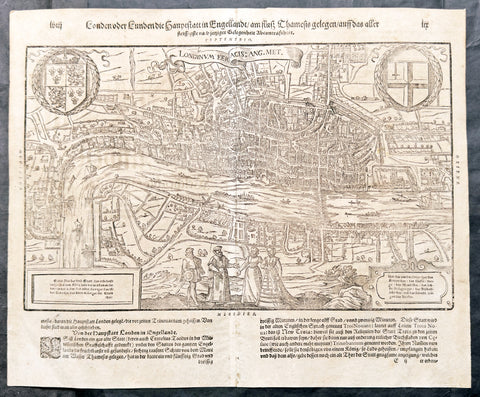
1598 Sebastian Munster Rare Antique Map - Birds Eye View of London, England
Antique Map
- Title : Londen oder Lunden die Hauptstatt in Engellandt / am fluß Thamesis gelegen/ auff das aller fleißsigste nach jetziger gelegenheit abcontrafehtet
- Ref #: 51012
- Size: 15 1/4in x 12 1/2in (385mm x 315mm)
- Date : 1598
- Condition: (A+) Fine Condition
Description:
This scarce original 1st edition antique woodcut birds eye view, is the third earliest acquirable depiction of London. Prepared in 1598, it was the only depiction of London to appear in Sebastian Munsters publication of Cosmographia, appearing in only the three last Sebastian Petri editions.
Modeled on Georg Braun and Franz Hogenberg's 1572 plan, the city here is laid out as a plan, but the buildings and surrounding landscape are presented in elevation - thus giving the impression of a bird's-eye view, even to the extent of detailing gardens and showing bustling river traffic. Also, as with the Braun and Hogenberg, the view has included four figures in the foreground: a nobleman and woman, with their attendant maid and footman (he, armed with a sword), each dressed in the styles of the period appropriate to their positions.
General Description:
Paper thickness and quality: - Heavy and stable
Paper color: -
Age of map color: -
Colors used: -
General color appearance: -
Paper size: - 15 1/4in x 12 1/2in (385mm x 315mm)
Plate size: - 15 1/4in x 12 1/2in (385mm x 315mm)
Margins: - Min 1/2in (12mm)
Imperfections:
Margins: - Uniform age toning
Plate area: - Uniform age toning
Verso: - Uniform age toning
Background:
Sebastian Munster's woodblock map of London is one of the earliest maps of the city available to collectors. It shows London during the lifetimes of Queen Elizabeth I and William Shakespeare. This map is a derivative of the Braun & Hogenberg's map of 1572. Munster has even arranged the costumed figures in the foreground into the same poses. Instead of the Latin descriptions found in the lower corners of the map on the Braun & Hogenberg map, Munster has instead included two panels listing the seven gates in the City wall, from west to east.
The old St Paul's Cathedral with its original pointed spire sits at the centre of the map. The spire was destroyed in a fire in 1561, but frequently appeared on later depictions of the city. The cathedral itself was burnt to the ground during the Great Fire of 1666, after which Christopher Wren designed and built the modern cathedral. To the southeast of St Paul's is the old London Bridge, the only bridge crossing over the River Thames until the 18th century.
South of the river are two circular arenas for bull and bear baiting. This was a vicious, but popular, form of entertainment in Tudor London. Shakespeare's Globe Theatre would be built in 1599 on a parcel of land to the west of these arenas.
Located outside of the City of London's jurisdiction, Southwark was a riotous pleasure ground where Londoners went to escape the strict rules north of the river.
On the far left of the map is Westminster, a separate royal enclave surrounding St James's Palace and Whitehall linked to the city by the Strand and by the river. A royal barge is shown on the river to the west of London Bridge, depicting the monarch's typical method of traveling to avoid the crowded streets of the city. The royal coat of arms is appropriately placed in the upper-left corner above Westminster, while the upper-right corner contains the coat of arms of the City of London. (Ref: Shirley; Tooley; M&B)


