
1672 Nicolas Denys Extremely Rare Map of Acadia, Quebec, Nova Scotia Canada

Cartographer :Nicolas Denys

Description:
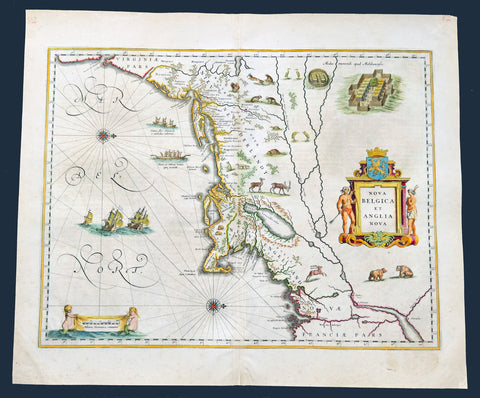
This original copper plate engraved, antique very rare map of Acadia, Nova Scotia in eastern Canada by the founding father of Acadia Nicolas Denys, was published in his  1672 edition of Description Géographique et Historique des Costes de l'Amérique Septentrionale.... 

The map is very rare, since a number of the copies of the book do not appear to have had the map included. From our research we have realised two versions of this map, with an obvious difference. One map that shows latitude 42 numeric at the bottom left and another edition without.
The map without the numeric 42 can be seen online, from the McGill university, digitised by the Haiti Trust online library, P #38.
The map with the numeric can be found on the Gallica open-access digital library of the Bibliothèque nationale de France (BnF)
Both are easily searchable on each site using Denys name.
There are also other copies to be found online.

The map carries 92 place names. On it Denys delineates the coasts he explored and traded on, from Penobscot Bay to Cap Gaspe, including all of Nova Scotia.
Nicolas Denys was a founding father of Acadia and one of its leading figures for over half of the 17th century. Denys was given Cape Breton Island by Louis XIV, in 1670, as a reward for services rendered. He wrote his account of the region at Nipisiguit on Chaleur Bay.
The map contains a number of place names, which are still in use today, that did not appear on earlier printed maps : Le Fort de St. Pierre, La R. de Cocanne, Le Cap de Tourmentin, Chedabouctou… Denys used the basic cartography of Sanson for mainland Nova Scotia, Quebec and New Brunswick, but with an entirely new, although distorted outline for Cape Breton.
He shows a large inlet, Le Lac de Labrador, which was sometimes retained by later cartographers, with its southwest corner separated by a wide isthmus from sea at Le fort de St. Pierre, present-day St. Peters Bay.

General Definitions:
Paper thickness and quality: - Heavy and stable
Paper color : - off white
Age of map color: -  
Colors used: -  
General color appearance: -  
Paper size: - 20 3/4in x 16in (680mm x 520mm)
Plate size: - 20 3/4in x 16in (680mm x 520mm)
Margins: - Min 1/2in (15mm)

Imperfections:
Margins: - Light chipping to left edge
Plate area: - Folds as issued, light creasing along folds
Verso: - Folds as issued, light creasing along folds, several small re-joins of folds to edges

Background: A century and a half after the first voyage of Columbus in 1492, northern North America beyond the Atlantic coastline was still barely known.
Before 1656 three entryways had been established: Davis Strait, Hudson Bay, and the St Lawrence valley It took another century and a half of laborious probing across the great plains and through the western mountains to reach the Pacific coast, where explorers met other Europeans who were arriving there too, overseas from the west.
Portuguese, Spanish, and Russians dominated the earliest coastal reconnaissance activity but then retreated. Inland the French uncovered what became Canada’s ecumene in the 20th century, while the British uncovered the rest of the landmass, all the way to the Arctic Ocean. The Canadian landmass was however revealed largely because it fed a craze for fur-based consumer products in Europe.
In the last years before 1632, inland explorers for the first time bridged gaps between places already known: between modern Quebec City and the coast of Maine, and between the Delaware River and Lake Ontario.
Throughout this period of 135 years, the coast of Labrador and northeastern Newfoundland were the most heavily traveled parts of the future Canadian territory.
Exploration of the fiords of today’s British Columbia coast and Alaska panhandle intensified in the last quarter of the eighteenth century, and in 1793 Alexander Mackenzie, a Montrealer, reached the head of one of those fiords at Bella Coola. He thus completed the land crossing of America begun some two centuries earlier.
After nearly two centuries, Great Britain was actively seeking the Northwest Passage and in 1818 a newly established border with the United States created another need for new and more accurate maps.

Nicolas Denys (1598? – 1688) was a French-born merchant, governor, writer, and settler in New France. He founded settlements at St. Pierre (now St. Peter's, Nova Scotia), Ste. Anne (Englishtown, Nova Scotia) and Nepisiquit (Bathurst, New Brunswick).
Denys' writings about the lands and peoples of Acadia were published in two volumes in 1672. The work, entitled The Description and Natural History of the Coasts of North America, remains the leading authority regarding the conditions of Acadia for the years 1632 through 1670.

When Cardinal Richelieu authorized a stronger French presence in the New World, he commissioned Isaac de Razilly to be lieutenant-general of Acadia and Nicolas Denys accompanied the expedition as one of de Razilly's lieutenants. The expedition set sail in 1632 with 300 hand-picked men, supplies, six Franciscan missionaries, and Simon Denys (Denis) de La Trinité (1599-1678), brother of Nicolas Denys. Simon Denys was a future seigneurial attorney and receiver general for the Compagnie des Cent-Associés, who was appointed to the ruling Sovereign Council of New France in 1664, then ennobled by Louis XIV, in 1668.
They founded a colony at the LaHave River where Denys engaged in inshore fishing, lumbering and fur trading. French administrators, including nearby Port Royal's lord, the Sieur Charles de Menou d'Aulnay, thought little of the colonists’ reclaiming tidal marshlands. Denys was very impressed with the “great extent of meadows which the sea used to cover and which the Sieur d'Aulnay has drained” It was this extensive system of dikes and drainage sluices (called aboiteaux) that set his colony apart from any others. It allowed the colonists to reclaim land that the Mi'kmaq nation had no use for. This greatly aided peaceful co-existence with their neighbors, and Mi’kmaq trade, friendship and intermarriage was and is an immensely important part of the Acadian identity and heritage.
When Denys arrived in 1632 the aboriginal community was already using iron kettles, axes, knives, and arrowheads, but few had firearms. Before the use of kettles the Mi’kmaq used hollowed out tree trunks in which to boil their unsalted food, dropping in hot stones to heat the water. Possessing kettles, they were free to move anywhere and became more mobile, changing their habitations often. Denys remarked on excessive hunting in his diaries. Moose, formerly in great numbers on Cape Breton Island, had been exterminated by hunting with muskets. There were no longer any moose on Prince Edward Island and the caribou were in reduced number. Alcohol, however, not over-hunting, was a major cause of Mi’kmaq decline.
When de Razilly died in December 1635 the colony broke up and Nicolas Denys returned temporarily to France. In 1636, Denys was granted a seignory by the French crown, apparently the third grant in the colony of Acadie and in 1642 he married Marguerite de Lafitte in France, but soon took his new family across to his adopted lands of Acadia.
Denys was a witness to one of the most unfortunate chapters of early Acadia's history: the rivalry between the Lords d’Aulnay and Charles de Saint-Étienne de la Tour, as it dissipated efforts to grow the colony. La Tour had claimed royal permission to ply the fur trade in the American Northeast. His rival outposts were in often-open hostility with the budding d’Aulnay colony, competing for resources and markets. Decades of sparring led to bloodshed. In the Spring of 1643 La Tour led a party of English mercenaries against the Acadian colony at Port Royal. His 270 Puritan and Huguenot troops killed three Acadians, burned a mill, slaughtered cattle and seized 18,000 livres' worth of furs. D'Aulnay retaliated in 1645 by seizing all of La Tour's possessions and outposts while La Tour was drumming up more support for his cause in the English colonial port of Boston. Denys’ letters and journals give vivid descriptions of the drama.

Once he secured rights to his own lands in Acadia through the Company of New France, Denys continued to seek his fortunes now as the Governor of Canso and Isle Royale (present-day Cape Breton Island). Denys founded settlements at St. Pierre (now St. Peter's, Nova Scotia, site of the Nicholas Denys Museum), Ste. Anne (Englishtown, Nova Scotia) and Nepisiquit (Bathurst, New Brunswick).
His 'fortunes' had some reversals, however. Sieur Emmanuel le Borgne, a rival with holdings at Port Royal, seized his properties by armed force in 1654 while Denys was at Ste. Anne. Later that year, King Louis XIV recognized Denys’ claims to the property lost to le Borgne  and Le Borgne was commanded to restore them to Denys.
The Denys family, including his wife and son Richard Denys, made their home in St. Pierre, and dwelt there in relative calm until the Winter of 1669, when Nicolas’ home and business were consumed in a fire. Denys relocated his family to Nepisiquit, on Baie Chaleur, just south of the Gaspé Peninsula, and there he turned his efforts to writing. Leaving his son Richard in charge of his holdings, he travelled to Paris to publish his Description Géographique et Historique des Costes de l’Amérique Septentrionale: avec l’Histoire Naturelle du Païs. Released in 1672, it was not a success. He remained in Paris for several years, returning impoverished to Nepisiguit a few years before his death.

Denys died in 1688 at Nepisiquit, a town of his own creation. During his tenure in the New World, he appears to have offered more stability of governance than those other royal appointees around him. Denys is well known through his writings about the lands and peoples of Acadia, especially his Description, published in two volumes in 1672. This work was edited and translated into English by Professor William Francis Ganong and published in 1908 as part of the Champlain Society's General Series. Ganong was a distant cousin of Denys.
Nicolas Denys and his work, translated as Description and Natural History of the Coasts of North America, remains the leading authority regarding the conditions of Acadia for the years 1632 through 1670.

Please note all items auctioned are genuine, we do not sell reproductions. A Certificate of Authenticity (COA) can be issued on request.

$12,500.00